
Healthy soil and clean water.
Here’s what’s going on in our field, and why it matters to you as a neighbor.
Hi, I’m Andy, founder of the Hillside Fund. I have some farm land, and I’m testing out ways to reduce our use of fertilizers.
In short, my goal is to have healthy soil → healthy food → healthy people.
We’re trying to improve the soil without dumping tons of chemical fertilizer into it — and in a way that keeps your drinking water and our community healthier.
Let me explain why that matters, because the problem is much bigger than most realize. And it can literally mean the difference between life or death.
Cancer is a problem in Nebraska, and our farming practices are at the root it …
If you’ve lived in Nebraska long enough, you know nitrates in the water have been getting worse. And that causes lots of problems for people who drink from that water. Conventional fertilizer is one of the biggest sources of that problem. Here’s the data …
Tens of thousands of Nebraskans drink water from wells with elevated nitrate levels. Nearly 33,000 Nebraskans get drinking water from wells affected by nitrate contamination — far more than are affected by arsenic or uranium. (UNL Water).
Many private and rural wells exceed safe limits. A recent statewide study found that roughly 17% of private wells sampled had nitrate levels above the safety threshold. (Nebraska Public Media). More than 6,000 wells were above the limit the last time they were tested (Flatwater Free Press).
Even “okay” wells often hover right under the limit. On average across Nebraska domestic wells, nitrate levels are above 7 mg/L — uncomfortably close to the 10 mg/L threshold considered safe under federal standards. (waterforfood.nebraska.edu)
Conventional farming contributes significantly to nitrate leaching. Over-application of nitrogen fertilizers on irrigated row crops (such as corn and soybeans) has been identified as a primary source of groundwater nitrate contamination in Nebraska (UNL Water). Additional contributions come from feedlots, lawn, and golf course fertilizers. Despite worsening contamination, state and local governments have never fined or stopped anyone for using excessive nitrogen fertilizer (Flatwater Free Press).
And the way many fields are still worked — heavy tillage, heavy chemicals — leaves the soil weak and more likely to erode or leach nutrients. Repeated tillage and chemical-heavy farming weaken soil structure, reduce its ability to retain water and nutrients, and increase the risk that fertilizers and rainwater carry nitrates into groundwater or nearby surface waters. (NRDC)
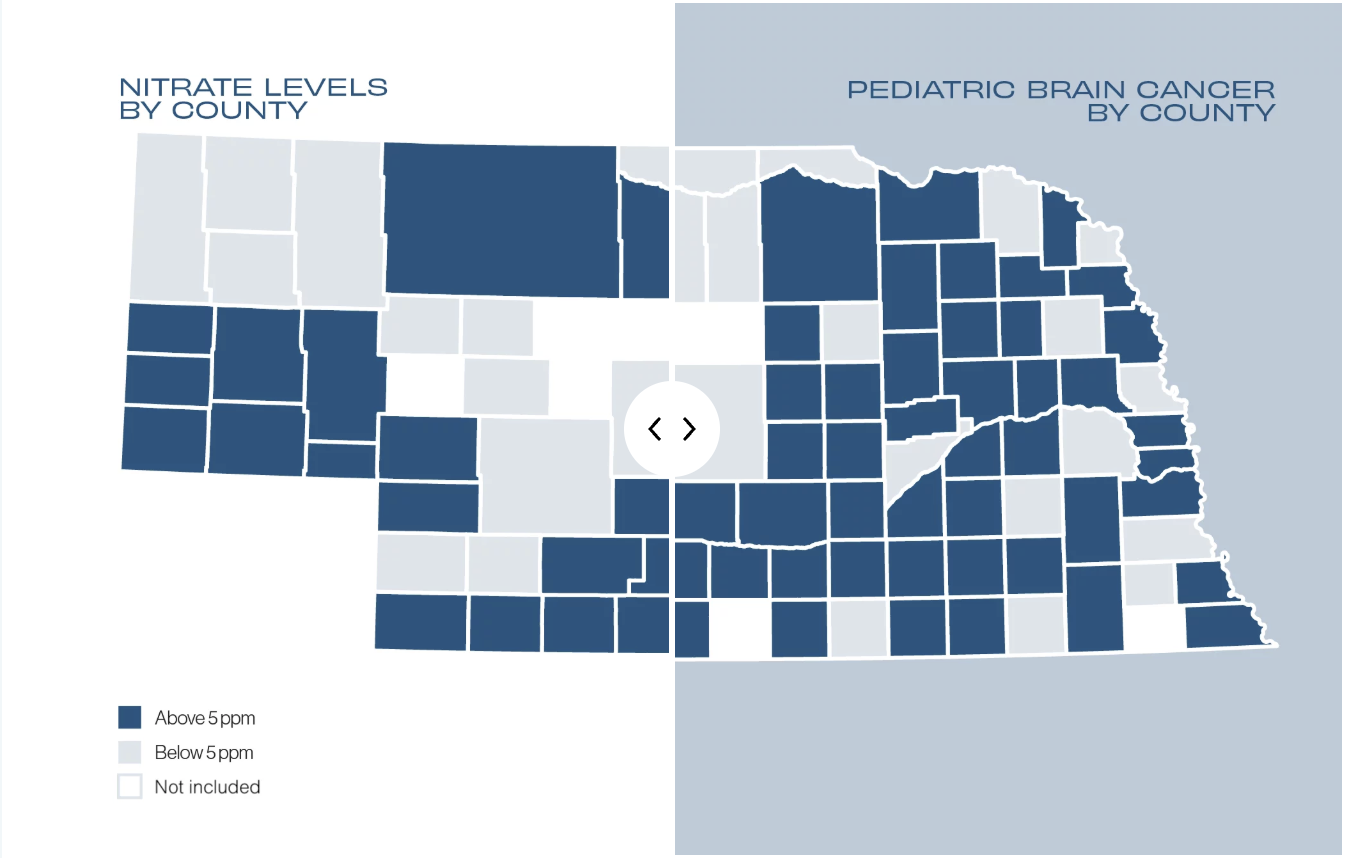
Click on the image to see this interactive map that compares nitrate levels in the water to cancer rates.
Here’s why all this info matters to you:
Long-term health concerns — especially for children — are real.
Experts worry that elevated nitrates in water may be linked to a higher risk of pediatric cancers and other serious health issues among people drinking well water (Nebraska Public Media). University of Nebraska Medical Center studies have found that areas with higher nitrate levels in water also have higher rates of pediatric lymphoma, leukemia, and brain cancers, and Nebraska now has the highest pediatric cancer rate west of Pennsylvania (Flatwater Free Press).
All of this hits rural neighbors first, especially people on wells.
And if you farm, you feel the pressure too — fertilizer prices, input dependence, unpredictable rain patterns, declining soil structure.
It’s a lot. And it’s not sustainable. So we’re trying to do something different here.
Here’s how we’re trying to help …
We’re reusing clean, organic materials — leaves, grass, food scraps, and similar natural resources — and putting them back into the soil so it can rebuild itself.
The idea is simple: Healthier soil needs fewer chemicals, which means fewer nitrates in the water and fewer sprays in the air.
Fertilizers kill microbial life in the soil over time. And when you stop beating the soil to death, it comes back to life. Literally.
That’s when things start changing:
Birds return.
Earthworms show up again.
Soil stays on the field instead of blowing away.
And crops grow deep, strong roots instead of tall, stressed stalks.
This isn’t a trend. This is how we keep farming viable for the long haul.
Here’s our proof …
Here’s an example of two soybean fields planted the same day, right next to each other. But the results couldn’t have been more different.
On the left was the neighbor’s field, grown with synthetic fertilizers. On the right was ours—managed with natural soil-building practices.
When we pulled plants from each field, the difference was striking: our beans had stronger, deeper root systems and even earthworms clinging to the roots. The neighbor’s plants grew taller, but that height came with problems—more lodging late in the season and heavier insect damage on the leaves.
And the yields? Even in a drought year, our field produced 50 bushels, proving that healthy, living soil can weather tough seasons and still deliver.
This is what regeneration looks like—stronger plants, healthier soil, and resilience you can see right in your hands.
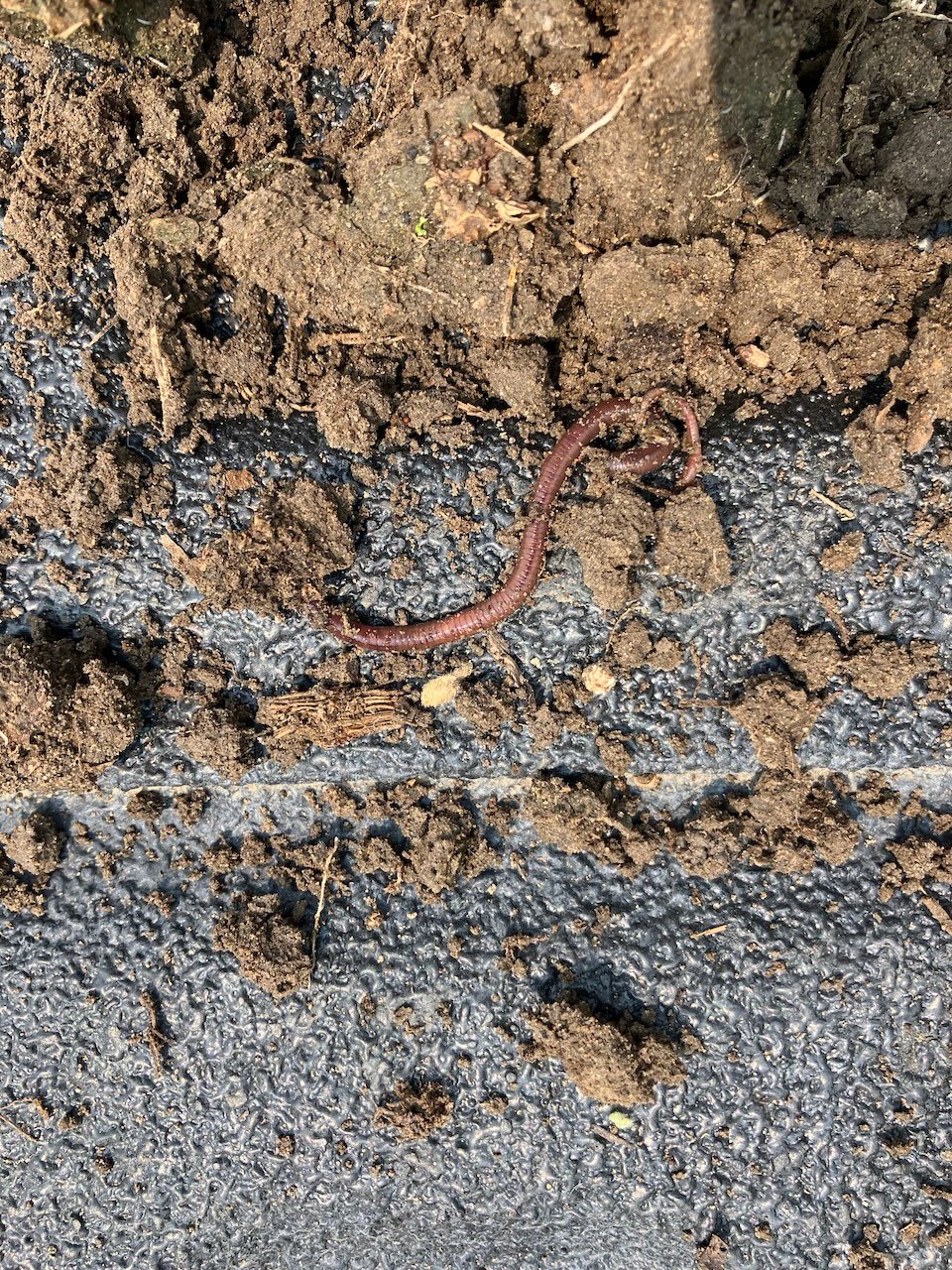
Here’s a worm in our soil!
How this benefits you as a neighbor:
Cleaner drinking water. Less synthetic fertilizer means fewer nitrates in groundwater.
Less chemical drift. Healthy soil doesn’t need as many inputs. That’s less spray anywhere near your house or your kids.
More wildlife. Good soil brings back worms, pollinators, birds, all of it.
Less erosion blowing into your yard. The ground actually holds together again.
A healthier place to live. Not just for you — but for your whole community.
How these practices benefit farmers:
You already know the game: inputs are expensive, and soils that used to “just work” don’t anymore.
Here’s what resource-reuse and soil regeneration do for a working farm:
Builds real soil structure that can handle heat, drought, and heavy rain.
Reduces fertilizer bills over time.
Helps roots grow deeper (meaning better yields in dry years).
Supports natural pest control — less chemical rescue treatment.
Makes the farm more profitable long-term instead of year-to-year guessing.
Farmers who stick with it usually end up wondering why they didn’t start sooner.
Will one field make a difference?
No, one field won’t.
But the idea is that when we find something that works (while being good stewards to our neighbors), we’ll share that with other farmers to do the same.
Over time and over our network, this will make a positive difference.
In the meantime, we wanna be good neighbors. So we welcome feedback and conversation.
Want more info or give us feedback?
Want one of the best books on regenerative farming for free? We’ll mail you a copy of Dirt to Soil by Gabe Brown. We’d be happy to send you a nitrate water testing kit as well, or arrange a tour.